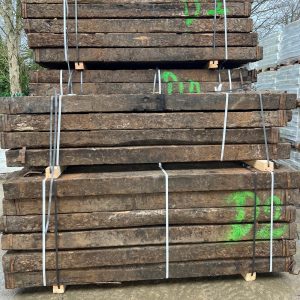
Reclaimed Sleeper Uses and Safety

When Britain’s railway network expanded during the Victorian era, engineers knew that supporting cast iron rails and the weight of steam locomotives demanded timber of real strength and longevity. The sleepers were treated with preservatives—mainly creosote—to fight rot, resist the weather, and endure the endless punishment of railway operations. Many reclaimed sleepers you can buy today have been in service for fifty, sixty years or more, a testament to both the timber quality and how well those preservation methods worked.
Why This Matters
Three things make reclaimed sleepers worth considering: sustainability, durability, and how they look.
On sustainability – and this matters more and more to homeowners. Choosing reclaimed sleepers means you’re not driving demand for newly harvested timber. That eases pressure on forests and extends the life of materials already felled. It’s a practical way to create attractive outdoor spaces while thinking about resources. The benefit goes beyond just reusing something; it’s about making thoughtful choices for home improvement that acknowledge we can’t endlessly harvest new materials.
Durability is another good reason to take notice. These sleepers have already weathered decades of exposure to rain, moisture, and the constant stress of trains passing over them. If timber can survive that, properly installed in your garden it’ll give you many more years of reliable service. That proven track record gives you genuine confidence in your investment.
Then there’s the look of them. That weathered appearance, the patina built up over years of railway service, brings immediate character to garden features. This isn’t shiny new timber fresh from a mill; it’s material with history, creating a rustic, established feel that most homeowners find far more appealing than new wood.
Before you use sleepers, you do need to understand the different types available. What kind of sleeper you get determines where you can safely put it, particularly if you’re planning projects that involve regular contact with skin or food production. Getting this right protects your family and makes sure your project works properly long-term.
Understanding Sleeper Types and Characteristics
Oak sleepers have several things worth knowing about. Oak is one of Britain’s most respected hardwoods, valued for its natural strength and density. Reclaimed oak sleepers look beautifully aged, often with what’s called “waney edges”—where the natural curve of the original tree is still visible along the edge, adding to that rustic feel. Oak doesn’t take creosote treatment as readily as softwoods do, so reclaimed oak sleepers often appear less heavily treated than their softwood equivalents, which affects what you can use them for.
When it comes to weight, oak sleepers are genuinely substantial. A single sleeper of standard dimensions—around 2.6 to 2.8 metres—weighs roughly 70 to 80 kilograms. That’s about the same as moving a large adult, and you’ll need help to lift one safely. Oak’s exceptional durability comes with that considerable weight.
Azobe sleepers—sometimes called ekki or red ironwood—take durability to another level entirely. Azobe comes from West Africa and became part of Britain’s railway infrastructure precisely because of how phenomenally strong and resistant to rot it is. This tropical hardwood has natural oils that protect it against decay and insects, making it exceptionally long-lasting even without chemical treatment.
Azobe sleepers are notably heavier than oak. The same dimensions typically weigh between 90 and 110 kilograms—comparable to moving a full-grown adult male. That weight should give you pause when you’re thinking about how to handle these materials. The density that makes Azobe so tough also makes it considerably heavier than most timber you’d encounter in landscaping.
Both oak and Azobe are genuinely strong. They can support significant weight without bending or breaking, which is why they were used for railways in the first place and why they’re still popular for structural landscaping features like retaining walls and load-bearing steps. Properly installed, they’ll keep working for many years.
Treated vs Untreated Sleepers: A Critical Distinction
The difference between treated and untreated sleepers has serious implications for how you can use them.
Creosote has a long history as a timber preservative. This thick, oily substance—originally derived from coal tar—soaks into timber fibres and protects against rot, fungi, and insect damage extremely effectively. When Britain’s railways were being built and expanded, engineers needed sleepers that would last decades while constantly exposed to moisture, buried in ballast, and subjected to enormous forces. Creosote did that job brilliantly, which is why so many reclaimed sleepers you can buy today are treated with it.
Treated sleepers are the ones that received creosote during their railway days. You’ll spot them by their dark, sometimes oily appearance and characteristic smell. They’ve proved their durability over decades, but that effectiveness comes with important restrictions on where you can use them.
UK Department of Trade and Industry guidance is clear: you can’t use treated sleepers inside buildings. You shouldn’t use them in toys, playgrounds, parks, gardens, or outdoor spaces where people might touch them regularly. You can’t use them for containers meant to grow food, or for packaging that might contact food for people or animals.
The reason is straightforward: creosote can harm your skin with frequent contact. The DTI is explicit about this—when you handle treated sleepers, you must wear protective gloves to protect yourself from skin irritation and chemical exposure.
Untreated sleepers give you far more flexibility. These are reclaimed sleepers that either never had creosote applied or came from railway sections that used alternative preservation methods. You can use untreated sleepers for raised beds and planters where you’ll grow vegetables, herbs, or flowers. They’re fine for sleeper driveways, stepping stones, and steps where people walk regularly. You can use them for exterior walls, lawn edging, and much else besides.
The practical difference is clear: if your project involves growing food or frequent human contact, untreated sleepers are your only safe choice. If you’re building structural landscaping features where contact will be minimal, treated sleepers might work—but you must handle them with gloves and think carefully about location.
Safe Usage and Handling Guidelines
A single reclaimed railway sleeper weighs between 70 and 110 kilograms depending on timber type. That’s a serious amount of weight in an awkward shape with nowhere convenient to grip.
Don’t try to handle one alone. It’s genuinely unsafe. Attempting to lift, carry, or move a sleeper by yourself puts your back, joints, and muscles under strain they simply can’t handle. The risk of serious injury—particularly to your lower back—is real and substantial. These materials need at least two people to handle safely, preferably three if you’re dealing with heavier Azobe sleepers or working in tight spaces. Even with a team, use proper lifting technique: bend at the knees, keep your back straight, lift with your legs, and talk clearly with anyone helping you. Consider mechanical help where you can—trolleys, sack trucks, or small machinery if you’re moving multiple sleepers.

Plan your delivery beforehand. Suppliers usually deliver by tipper van, leaving sleepers at the nearest hard-standing area the vehicle can reach. The driver won’t help move them because of health and safety rules, so you need your own labour lined up to get them from the delivery point to where you’re working. Sort this out before you order.
Once they’re in position, securing them properly becomes critical. Sleepers in landscape projects need to resist forces that’ll act on them—soil pressure against retaining walls, the weight of people on steps, sideways movement on driveway edges. Depending on your project, you might need substantial coach screws, galvanised brackets, reinforcing rods driven through the sleepers into the ground, or concrete footings. Your fixings need to match both your timber type and what your project actually demands.
Safety doesn’t stop once things are installed. If you’re working with treated sleepers, wear gloves throughout—delivery, positioning, cutting, drilling, any adjustments. Keep children and pets away from the work area, both because the materials are heavy and because you want to avoid contact with creosoted surfaces. When you cut or drill treated sleepers, work outside to stop creosote dust building up indoors, and consider a dust mask to avoid breathing in particles.
Creative Applications for Reclaimed Sleepers
With the safety side sorted, here are the genuine possibilities that reclaimed sleepers offer UK homeowners for garden landscaping.
Raised beds are probably the most popular use, and rightly so. Sleepers create instant structure—stack them to whatever height your plants need. One sleeper gives you about 150mm of depth. Remember though: if you’re growing food, you must use untreated sleepers to avoid chemical contamination of your soil and crops.
Retaining walls show off what sleepers can do structurally. If your garden has changes in level, sleepers can create terracing that’s both practical and striking to look at. Their proven ability to handle pressure and moisture makes them ideal for holding back soil, and their chunky profile adds immediate character. Installed properly with the right fixings and drainage, sleeper retaining walls last for years.
Garden steps work brilliantly with sleepers thanks to their uniform size and natural grip. Whether you’re making a gentle slope with a few broad steps or a steep climb needing more treads, sleepers give solid, reliable footing. The weathered surface actually grips better than many alternatives, especially when wet.
Driveway edging is another practical application. Sleepers create robust borders that define parking areas and stop gravel spreading onto lawns or flower beds. Their weight and stability mean they resist getting pushed around by car tyres or weather.
For oak sleeper applications specifically, think about how oak’s lighter tone and natural grain work with traditional English gardens. Oak sleepers suit features where you want to appreciate the timber’s character—bench seating, decorative borders, or feature walls where the wood’s natural beauty is part of the design.
Exterior feature walls are increasingly popular, creating vertical interest and defining outdoor spaces within larger gardens. Sleepers can form the structure for pergolas, covered seating areas, or screening that gives privacy while keeping that rustic feel. The key is securing them properly with fixings that account for the weight.
Lawn edging might seem modest, but sleepers excel at it. One sleeper laid horizontally creates a robust mowing edge that defines your lawn boundaries and gives your mower a solid surface to run along. It stops grass gradually creeping into flower beds and creates clean lines throughout your garden.
Environmental and Sustainability Considerations
The environmental benefits of repurposing railway sleepers deserve real thought, because they go beyond simply finishing your project. Choosing reclaimed sleepers supports a circular economy by reusing materials instead of sourcing new ones.
Forestry pressure is a genuine concern. Every piece of reclaimed timber you use is timber that doesn’t need to be freshly cut down. This reduces demand on British woodlands and tropical forests where hardwoods like Azobe come from. Sustainable forestry exists, but reducing overall timber demand is better than increasing it regardless of how well forests are managed.
More UK homeowners are recognising that “reclaimed” doesn’t mean “second-rate”—quite the opposite with railway sleepers that have already proved their durability over decades. This shift towards valuing existing materials rather than automatically choosing new ones represents real progress towards more sustainable consumption.
Looking ahead, reclaimed materials are likely to feature more prominently as environmental concerns intensify and resource awareness grows. The construction and landscaping sectors will increasingly focus on reusing materials and embracing circular economy principles. Railway sleepers exemplify this perfectly—materials engineered for exceptional longevity now finding new applications that extend their useful life by many more decades.
There’s something rather satisfying about knowing your garden features materials with genuine history. These sleepers supported Britain’s railway network as it evolved; now they support your roses, define your driveway, or create your garden steps. That continuity of purpose, adapted to new contexts, is sustainability in its most practical and appealing form.
Reclaimed Sleepers